
As digital transformation accelerates, driven by AI, cloud, and data, it is easy to overlook the environmental cost of this revolution. Yet the numbers are clear: digital technologies already account for nearly 4% of global greenhouse gas emissions, a figure that could double by 2025 if no action is taken (Le Monde, 2024).
For me, as an Astek expert leading our expansion in the United States, Green IT is no longer optional: it is an operational and ethical requirement. And the good news is that sustainability does not mean slowness — it often goes hand in hand with intelligence, performance, and efficiency.
What is Green IT?
Green IT encompasses all practices aimed at reducing the environmental impact of digital technologies throughout their lifecycle: design, development, hosting, usage, and end-of-life.
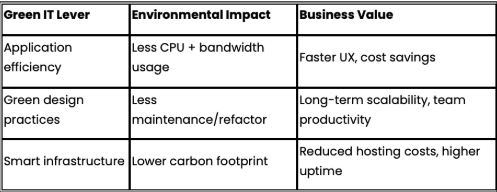
Three key levers for designing sustainable applications
1. Application Efficiency: do less, deliver more
Efficiency starts by questioning which functionalities are truly necessary. Many applications are oversized, execute redundant processes, and unnecessarily use CPU and memory resources without delivering proportional value.
Quick actions:
- Remove unnecessary processes (e.g., duplicate queries)
- Optimize memory and logical flows
- Compress data and media
- Simplify interfaces (animations, overly heavy frameworks)
A well-optimized web page can consume up to 80% less bandwidth (Forbes, 2023). Result: faster applications, lower operational costs, and a reduced energy footprint — a major concern in areas with limited hosting or connectivity.
2. Green by Design: think sustainability from the start
Sustainability should not be an afterthought but a structuring choice from the earliest design stages.
Best practices:
- Favor simple, maintainable architectures
- Avoid unnecessary proliferation of microservices
- Control feature additions during agile sprints
- Choose long-lasting and well-documented frameworks
A clean design reduces total cost of ownership (TCO), improves performance, and limits constant refactoring — key concerns for IT departments.
3. Smart Infrastructure: host better, transfer less
Data centers already account for 4–6% of electricity consumption in the United States, with projections reaching 260 TWh by 2026 (Le Monde, 2024).
Choosing sustainable hosting is no longer a matter of image, but a strategic necessity.
Concrete measures:
- Select cloud providers committed to local renewable energy (AWS, GCP, Azure)
- Use hybrid or edge architectures to limit duplication
- Reduce data transfers through intelligent caching, local processing, and compression
Benefits: lower emissions, reduced costs, greater resilience — without compromising performance.
Why Green IT is a business lever?
With these three pillars, Green IT becomes a competitive advantage rather than a constraint.
AI, Cloud & Data: making the heart of IT sustainable
These technologies are often perceived as energy-intensive — and they can be. But a well-designed architecture changes the game.
Watch points:
- AI models running 24/7 for occasional tasks
- Data lakes saturated with redundant or low-value content
- Oversized cloud infrastructures “just in case”
Sustainable approaches:
- Use pruning and quantization for AI models
- Implement data prioritization and retention policies
- Automate resource scaling to avoid idle loads
According to Reuters and the ITU (UN), emissions from cloud and AI workloads have increased by 150% in three years, mainly due to uncontrolled growth of hyperscalers (Reuters, 2025).
Tomorrow’s clients will ask: “What is your digital footprint?”
“Within two years, Green IT will shift from being a buzzword to a strategic selection criterion, based not on labels but on real expertise and measurable actions.” – Julien DELVAL
In North America in particular, tech buyers are increasingly sensitive to ESG criteria.
They want clear answers:
- How is your code designed?
- Where is your infrastructure hosted?
- What is the carbon footprint of each project?
Companies that integrate sustainability into their delivery DNA will gain trust and long-term viability.
The new equation of digital technology
It is time to challenge the idea that “more power = more value.”
With smart design, optimized infrastructure, and an efficiency-focused approach, applications can be:
- Faster
- Less costly
- More sustainable
- More resilient
At Astek, we believe that the future of IT will not only be digital — it will be sustainable by design.

Julien DELVAL
Global Account Manager


Thomas SLOUKGI
Communication Officer